Biology Program
School of STEM
Biology Department
Stern Hall, Room 122-G
2601 Gentilly Boulevard
New Orleans, Louisiana 70122
(504) 283 – 8822
biology@dillard.edu
Office Hours:
M-F 8 a.m. - 5 p.m.
College of Arts & Sciences
School of STEM
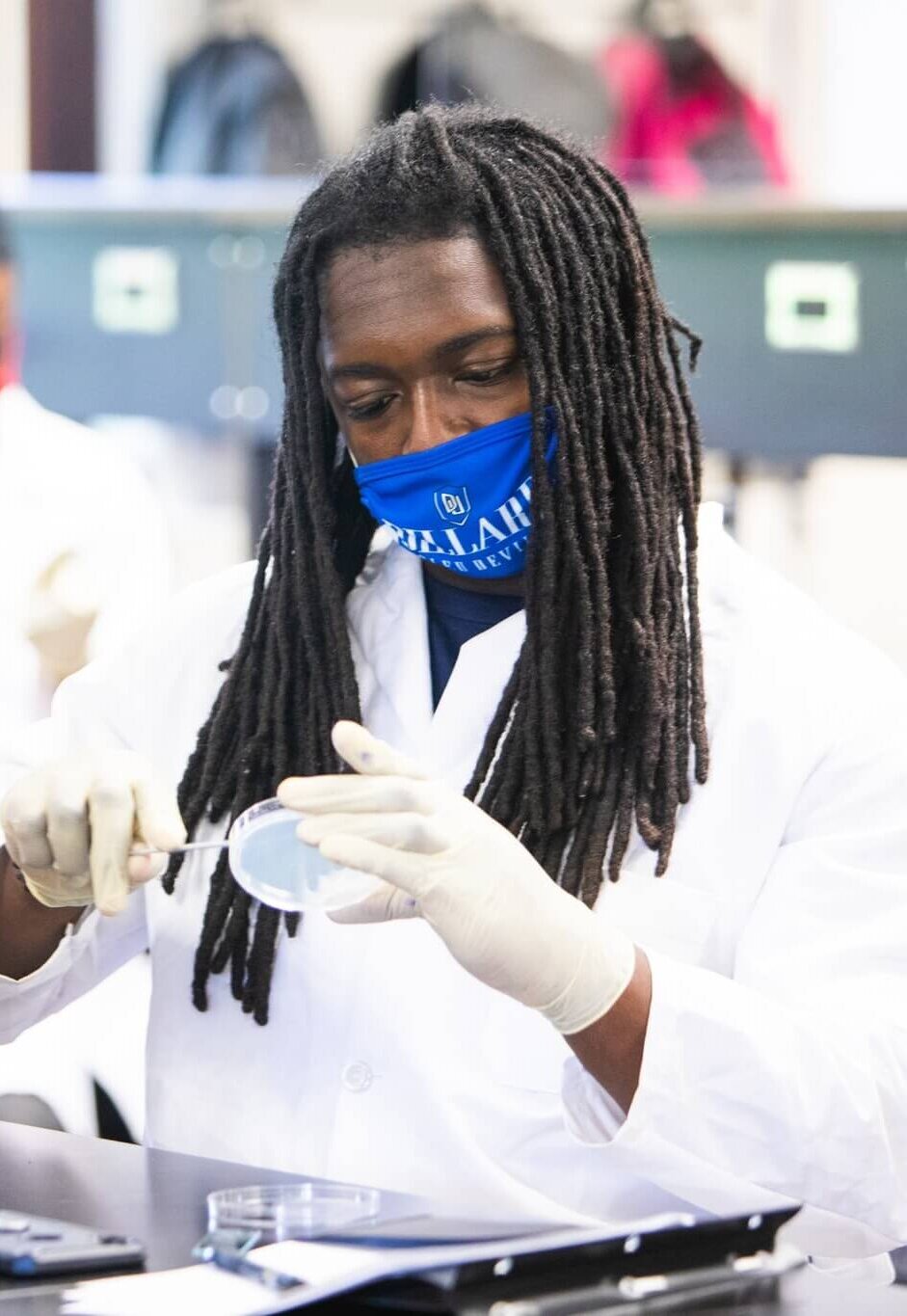 Biology is where the study of life comes alive. Dillard University offers a fascinating
exploration into the origin, growth, function, and evolution of living organisms.
We believe that biology is more than just a subject; it is a powerful tool for creating positive change in the world. Whether you aspire to become a healthcare professional, a researcher, an environmentalist, or a policymaker, our biology program equips you with the scientific foundation necessary to earn your bachelors degree and tackle real-world challenges head-on.
In the United States and globally the health disparities plaguing our society has created an urgent need for change-agents and advocates who can make a difference. The Dillard Biology program is here to empower you with the scientific knowledge and skills to become that change-agent. Our program goes beyond textbooks and lectures to provide hands-on experiences that will ignite your passion for biology. From field research to laboratory experiments, you’ll have the opportunity to investigate and understand the intricate workings of life.
Explore the Future of Science and Healthcare
Biology Degrees and Programs
Bachelor of Science in Biology
Explore the field of biology through our rigorous program, encompassing 120 credit hours structured as follows:
- General Education Core: 35 credit hours
- Major Requirements: 41 credit hours
- Additional Coursework: 44 credit hours
Students will take part in hands-on learning and actively participate in community service initiatives, accumulating a total of 90 hours by the end of their junior year, facilitated by the Center for Career and Professional Development.
Bachelor of Science in Biology – Pre-Professional Concentration
In our Biology Pre-Professional Program, students cultivate essential skills and experiences to excel in
their field:
- Demonstrate a broad-based knowledge of concepts and terminology in cellular, molecular, organismal, and ecological biology;
- Analyze, solve problems, understand relationships, and interpret information in the biological sciences and supporting fields;
- Communicate scientific information in a clear and concise manner both orally and in writing.
To follow this curriculum, students must receive prior approval from the Biology Program Coordinator (or designated committee) and maintain a cumulative grade point average of 3.5 or higher. Completing a total of 123 credit hours of coursework for graduation, students engage in:
- General Education Core
- Major Requirements
- Additional Coursework
Furthermore, our program integrates service learning, where students earn a total of 30 service learning hours upon successful completion of foundational courses. Additionally, students actively participate in community service initiatives, accruing a total of 90 hours by the end of their junior year through pre-approved projects coordinated by the Center for Career and Professional Development.
Dual Degree Programs
- Boston University, College of Medicine (BS/Medical Doctor) - Early Admission
- New York College of Podiatric Medicine (BS/Doctor of Podiatric Medicine)
- Texas Chiropractic College (BS/Doctor of Chiropractic Medicine)
Biology Minor
Earn your biology minor by completing 20 credit hours of diverse coursework, enhancing your understanding of biological principles and applications.
* For the most current program requirements and updates, please refer to the Dillard University Academic Catalog.

Student Learning Outcomes:
Demonstrate a broad based knowledge of concepts and terminology in cellular, molecular, organismal, and ecological biology;Analyze, solve problems, understand relationships, and interpret information in the biological sciences and supporting fields;
Communicate scientific information in a clear and concise manner both orally and in writing.